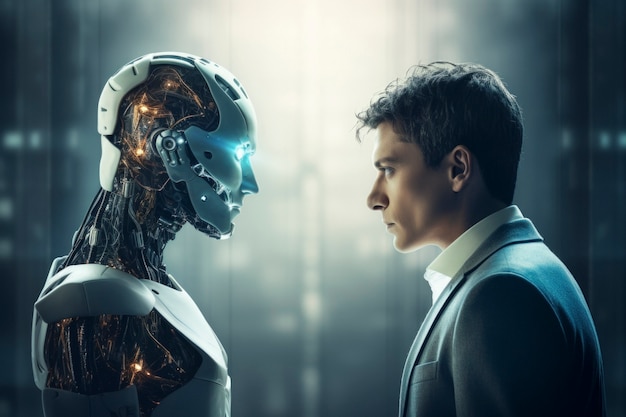
AI vs Human: Can Artificial Intelligence Truly Replace Human Intelligence?
Artificial Intelligence has rapidly become one of the most transformative technologies of our time. From automating tasks to generating content and supporting complex decision-making, AI is reshaping industries at an unprecedented pace.
As its capabilities continue to expand, a critical question has emerged: can AI truly replace humans?
This debate isn't just technological, but philosophical, economic, and practical. While some believe AI will eventually outperform humans in most areas, others argue that human intelligence possesses qualities that machines cannot replicate.
Understanding this balance is essential for individuals, businesses, and organizations navigating the future of work.
What AI Is Really Capable Of

Artificial Intelligence excels at processing large volumes of data quickly and accurately. It can analyze patterns, automate repetitive tasks, and generate outputs based on learned information.
AI systems are already being used in areas such as customer service, data analysis, content creation, and software development. They can operate continuously without fatigue and deliver consistent performance.
In structured environments where rules and patterns are clearly defined, AI can significantly outperform humans in speed and efficiency. This makes it a powerful tool for improving productivity and reducing operational costs.
However, these capabilities are based on data and algorithms, not independent understanding.
The Unique Strengths of Human Intelligence
Human intelligence goes beyond data processing. It includes creativity, emotional intelligence, ethical reasoning, and the ability to navigate complex, unpredictable situations.
Humans can interpret context, understand nuance, and make decisions based on values and experience. They can think critically, adapt to new environments, and innovate in ways that are not limited by predefined patterns.
Emotional intelligence is another key strength. Humans can empathize, build relationships, and communicate in ways that foster trust and collaboration.
These qualities make human intelligence uniquely suited for leadership, creativity, and complex problem-solving.
Where AI Outperforms Humans

AI’s greatest advantage lies in speed and scalability.
It can process vast amounts of information in seconds, identify patterns that might be invisible to humans, and perform repetitive tasks without error or fatigue. This makes it ideal for tasks such as data analysis, automation, and predictive modeling.
AI also excels in consistency. Unlike humans, it does not get tired, distracted, or influenced by emotions. This reliability is valuable in environments that require precision and repetition.
In industries where efficiency and accuracy are critical, AI provides significant advantages.
Where Humans Still Lead
Despite AI’s capabilities, there are areas where humans continue to lead.
Creativity remains a fundamentally human strength. While AI can generate content, it does so based on existing data. Humans, on the other hand, can create truly original ideas and think beyond patterns.
Judgment and ethics are also areas where humans play a crucial role. Decisions involving moral considerations, cultural context, and long-term implications require human insight.
Adaptability is another key factor. Humans can respond to unexpected situations and navigate uncertainty in ways that AI systems cannot fully replicate.
These strengths ensure that human intelligence remains essential, even in an AI-driven world.
The Future: Replacement or Collaboration?

Rather than replacing humans, AI is more likely to transform how humans work.
The future lies in collaboration. AI can handle repetitive and data-intensive tasks, allowing humans to focus on strategic thinking, creativity, and decision-making.
This partnership creates a more efficient and productive environment. Businesses that adopt this approach can achieve better outcomes by combining the strengths of both AI and human intelligence.
The goal is not substitution, but augmentation, enhancing human capability through technology.
How Don-Clem Technology Leverages AI Responsibly
At Don-Clem Technology, AI is approached as a tool for empowerment rather than replacement.
The focus is on integrating AI into digital solutions in ways that enhance efficiency while preserving human oversight. By combining advanced technologies with thoughtful design and development practices, the company ensures that AI supports business objectives without compromising quality or control.
This balanced approach allows organizations to benefit from automation while maintaining the creativity, judgment, and adaptability that only humans can provide.
Conclusion
The question of whether AI can replace humans is complex, but the answer is increasingly clear: AI is not a replacement - it is a tool.
While AI excels in speed, efficiency, and data processing, human intelligence remains essential for creativity, judgment, and emotional understanding.
The future of work will not be defined by competition between AI and humans, but by collaboration between the two.
Organizations that embrace this balance will be better positioned to innovate, grow, and succeed in an evolving digital landscape.