Electric Vehicle Fleet Management UK: Field Service Guide
Electric vehicle fleet management UK operators can rely on starts with the work, not the vehicle catalogue. A field-service business should match real routes, payloads, charging windows and emergency obligations to each vehicle before purchasing at scale. It should then test the proposed operating model through a controlled pilot.
What the July 2026 registration figures show
The Society of Motor Manufacturers and Traders published its July registration report on 5 August 2026. The figures cover vehicles registered during July.
The UK new-car market grew 11.7% year on year to 156,571 registrations. Battery-electric registrations increased 44.5% and reached a record 27.5% share for July. Fleet registrations rose 9.5% and represented almost six in ten registrations across the market.
A Reuters report on the figures published on 5 August also noted that electric demand was supported by model availability, incentives and manufacturer discounts. The figures concern new cars, not the suitability of a particular van or field-service fleet.
They nevertheless show that electric vehicles are becoming a mainstream fleet consideration. Service operators need a disciplined method for deciding which work can move first.
Why field-service EV transitions fail operationally
The common failure is treating vehicle replacement as a procurement project. A fleet is part of the service workflow. It connects the engineer, equipment, schedule, customer location, depot and emergency rota.
Average mileage hides the difficult day
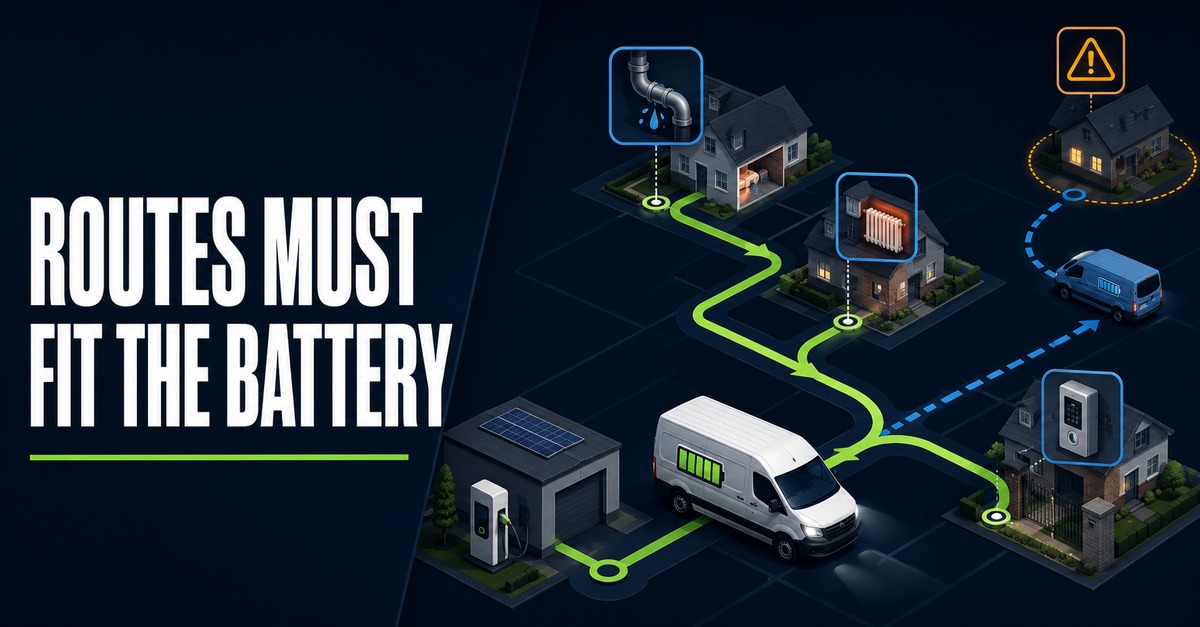
A van may average 70 miles a day while regularly covering 130 miles during winter peaks or emergency callouts. Planning around the average ignores the day most likely to cause a missed appointment.
Charging ownership is unclear
A depot manager may assume vehicles charge at home. Drivers may lack off-street parking. Dispatch may assume a public charger is available without accounting for travel, queues or charging time. If nobody owns the charging plan, vehicle availability becomes uncertain.
Schedulers cannot see the constraint
Traditional dispatch may assign the closest qualified engineer without considering battery state, payload or charging access. A late job can then affect the following shift.
Emergency cover is designed afterwards
Scheduled routes are easier to test than unpredictable work. A heating failure, water leak or access-control fault may arrive after the planned route is complete. Without a defined reserve, the customer carries the risk.
Costs are measured selectively
Energy and tax benefits can be visible while public charging, driver time, downtime and rescheduling remain outside the calculation.
An electric vehicle fleet management UK framework
- Build a route and duty profile: Use several months of actual journeys. Record start and finish points, daily and peak mileage, job duration, payload, equipment, parking conditions and time between appointments. Separate scheduled routes from reactive and on-call work. The Energy Saving Trust’s fleet telematics guidance recommends using accurate maximum daily mileage when assessing range and incorporating charging needs into route planning.
- Segment vehicles by suitability: Create three groups: suitable now, suitable with an operational change and not yet suitable. Predictable local routes with overnight depot dwell may enter the first group. High-mileage emergency vehicles may remain outside the initial pilot. Do not force the whole fleet into one timetable. A mixed fleet can protect service while evidence is gathered.
- Design charging around the shift: Map depot, workplace, home and public charging options. For each vehicle, define who connects it, when charging begins, the minimum required charge for release and what happens when a charger is unavailable. Check electrical capacity, installation lead time, tariffs and site access before ordering more vehicles than the infrastructure can support. UK Government support for electric vans and depot charging was announced on 25 March 2026, but each business still needs to confirm eligibility and operational requirements.
- Connect charging and dispatch decisions: Dispatch should know whether the vehicle is available, sufficiently charged and appropriate for the route and payload. The system should show the constraint before a job is assigned, not after the driver reports a problem. Define when a route may be changed, when another vehicle is required and who approves a charging stop that affects a customer appointment.
- Protect emergency and exception work: Test diversions, traffic, cold weather, an unavailable charger, a late finish and a second urgent callout. Specify the reserve vehicle, alternative driver, public-charging route and customer communication process. Service continuity should have an owner. “Use another van” is not a plan unless that van, driver and equipment are actually available.
- Pilot and compare complete evidence: Choose a small number of predictable routes and run the pilot through different operating conditions. Record energy, charging location, charge time, public-charging cost, downtime, maintenance, missed or moved jobs and driver feedback. Compare the electric vehicle with a similar existing duty cycle. Expand only when the evidence shows that operational reliability and the business case remain acceptable.
Businesses reviewing property-service workflows can explore real estate technology solutions alongside an IT consulting review of dispatch, charging and exception ownership. If the agreed workflow requires controlled connections between scheduling, telematics or charging records, custom software development may be considered after the process is defined.
An illustrative property-maintenance example
Consider a regional maintenance company with engineers completing planned inspections and urgent repairs. It selects two vehicles serving compact daytime routes for an electric pilot.
The first version assumes both vehicles will charge overnight at the depot. Route analysis then shows that one engineer takes the vehicle home while on call, and the property has no off-street charger. The company redesigns the pilot: one depot-based route continues, while the on-call vehicle remains outside scope until a reliable charging and emergency-cover process exists.
Dispatch receives the vehicle’s release status before the morning schedule is confirmed. A reserve vehicle is named, and any public-charging stop affecting an appointment requires an owned customer update.
This is an illustrative scenario, not a Don-Clem Technology customer result. It shows why route and charging evidence should decide the pilot boundary.
What technology should and should not do
Technology should connect job demand, route length, vehicle availability, charge status, skills and service deadlines. It should warn dispatch about conflicts, retain charging and exception evidence, and show who owns the next action.
Technology should not promise a fixed real-world range, assign an unsuitable vehicle because it is geographically closest, hide public-charging time or close an exception without confirming the customer outcome. Professional fleet, safety and electrical decisions remain with qualified people.
The system supports the operating model. It cannot compensate for missing chargers, unrealistic routes or absent emergency cover.
Frequently asked questions
- Which field-service vehicles should move to electric first?: Start with predictable routes, manageable peak mileage, reliable dwell time and charging that the business can control.
- Should planning use average or maximum mileage: Use both, but test peak and exceptional days. Average mileage alone can conceal the routes most likely to fail.
- Does every business need depot charging?: Not necessarily. The correct mix may include depot, workplace, home and public charging, but availability, cost and ownership must be verified.
- What should an EV fleet pilot measure?: Measure energy, charge time and location, public-charging cost, downtime, maintenance, route exceptions, service failures and driver feedback.
- Can dispatch software solve charging problems?: It can expose constraints and improve decisions. It cannot create electrical capacity, guarantee charger availability or replace a resilient operating plan.
Conclusion
Electric vehicle fleet management UK service operators can trust begins with route evidence and controlled exceptions. Match vehicles to suitable work, design charging around real shifts, protect urgent jobs and expand only after a pilot confirms service reliability.
Message me CHECKLIST for the field-service fleet transition checklist.