How to Run an AI Pilot for Business Operations
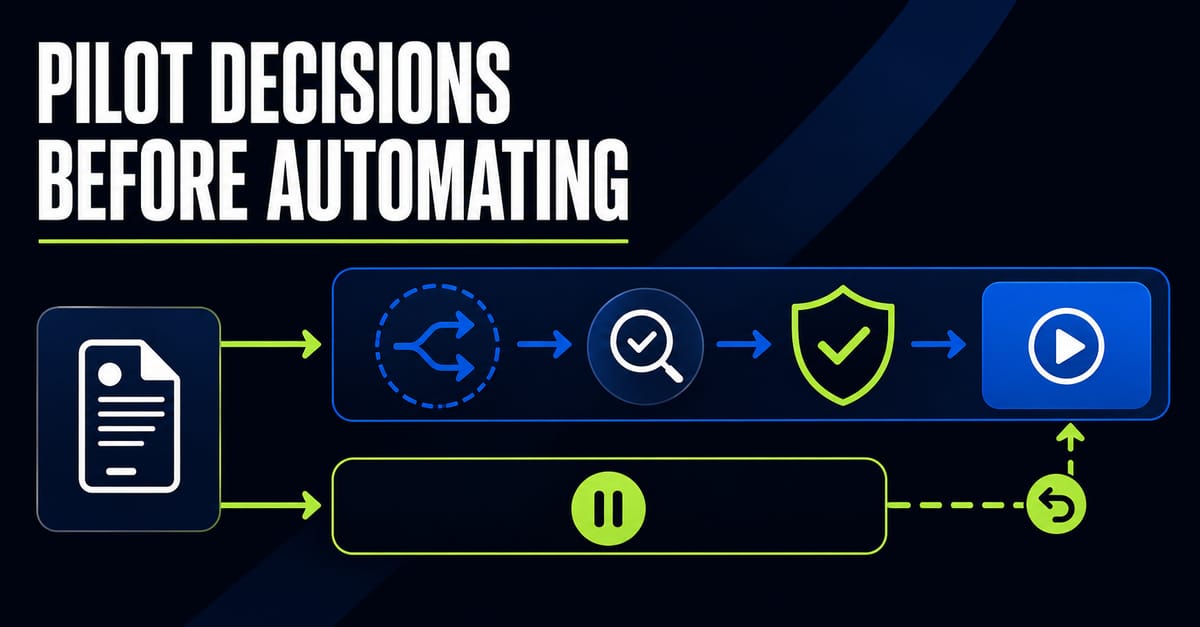
An AI pilot for business operations should not begin with unrestricted access to live decisions. Start with one defined workflow, run recommendations beside the existing process, require accountable human approval, set pause thresholds and prove that the organization can return safely to its previous method.
This gives leaders evidence without asking customers or staff to absorb uncontrolled implementation risk.
What happened on 12 August 2026
Ryanair announced a five-year agreement with Google Cloud on 12 August 2026. The airline said the arrangement would make Google Workspace and Google Cloud services available to 35,000 employees and support areas including crew logistics, operational decisions and infrastructure resilience.
Reuters filed its report late on 11 August UTC and described the agreement as a Wednesday announcement. It reported that the agreement adds Google Cloud to Ryanair's existing use of Amazon Web Services and that financial terms were not disclosed.
The dated event is the partnership announcement on 12 August. The sources describe intended uses. They do not provide evidence of completed implementation results, error rates or savings, so none should be inferred.
Why the implementation objection is valid
For a service business, operational decisions affect real people quickly. A rota change can leave a queue uncovered. A poor routing decision can delay an urgent repair. An inaccurate customer message can create complaints and repeat contact.
Leaders are therefore right to challenge a proposal that places a new system directly into a live decision path. The wrong response is to dismiss the concern as resistance. The better response is to convert the concern into pilot controls.
The choice is not between immediate automation and permanent manual work. A third option exists: controlled evidence gathering.
The common failed approach
Many implementation plans begin with the tool rather than the decision. Teams discuss integrations, interfaces and demonstrations before defining:
- Which decision is being supported.
- What evidence makes that decision acceptable.
- Who remains accountable.
- Which cases require manual handling.
- What would cause the pilot to stop.
This creates several risks.
First, a broad pilot makes failure difficult to diagnose. Second, staff may accept recommendations because the system appears authoritative. Third, managers may see faster processing while missing increases in correction work, complaints or service failure. Finally, the organization may have no tested route back when the process behaves unexpectedly.
A controlled AI pilot for business operations
1. Choose one bounded decision
Select a process with clear inputs, outputs and an accountable owner. Suitable early examples might include recommending the next available callback slot, identifying duplicate enquiries or suggesting a case category for review.
Avoid beginning with irreversible, safety-critical or legally consequential actions.
2. Establish the existing baseline
Measure the current process before introducing the pilot. Record handling time, correction work, missed commitments, customer complaints, manager interventions and relevant service outcomes.
Without a baseline, the organization cannot distinguish improvement from novelty.
3. Run in shadow mode
Allow the system to produce a recommendation without changing the live record, rota or customer commitment. Compare its recommendation with the decision made through the approved existing process.
Record agreement, disagreement and the eventual outcome. Shadow mode reveals limitations without transferring authority prematurely.
4. Define human approval properly
Human oversight must be more than asking someone to click approve. The reviewer needs enough information, competence, time and authority to challenge the recommendation.
The ICO’s guidance on individual rights and human oversight says people assigned to oversight should remain engaged, critical and able to challenge system outputs where appropriate.
5. Set operating limits
Define which records, teams, hours and decisions are included. Exclude sensitive or exceptional cases until the evidence supports expansion.
Set thresholds for error, manager override, complaint, rework and service deterioration. If a threshold is reached, pause the pilot automatically or through an accountable manager.
6. Test rollback before live use
Document how the organization will return to the approved existing process. Confirm that data recorded during the pilot remains accessible and that staff know when and how to switch.
A rollback plan that has not been rehearsed is only an intention.
7. Make the scale decision from evidence
At the review point, decide whether to stop, correct, continue or expand. Record the evidence and unresolved risks.
Do not increase scope merely because the technology operated without a major incident.
Illustrative contact-center example
Consider a property-services contact center testing a system that recommends priorities for new repair enquiries. This is an illustrative example, not a Don-Clem Technology customer result.
For four weeks, the tool reads approved, minimized case information and recommends a priority. It cannot update the live case. A trained supervisor compares each recommendation with the existing triage decision.
The review identifies that routine repairs are usually classified consistently, but cases involving vulnerability or repeated loss of service require more context. The team keeps those cases outside scope, adjusts the workflow and continues shadow testing.
Only after defined thresholds are met does the pilot allow recommendations to populate a draft field. The supervisor still approves the live priority, and a tested switch returns the team to manual triage if needed.
The pilot has produced useful evidence without treating customers as test data.
What technology should and should not do
Technology should preserve the decision trail, show the information used, record overrides, enforce operating limits and make rollback possible. It should help managers compare service outcomes before and during the pilot.
Business service technology solutions should reflect the real operating decision and its accountable owner.
IT consulting for operational systems can help define scope, controls and measures before implementation. Where existing platforms cannot support the approved workflow, custom software development may be considered against clear requirements.
Technology should not silently expand its scope, conceal uncertainty, approve its own exceptions or remove human accountability.
The ICO governance and accountability toolkit recommends assigning responsibility for oversight, defining roles and testing the governance framework regularly.
Frequently asked questions
- How long should a pilot run?
Long enough to include representative demand and exception cases. Use evidence thresholds and review points rather than choosing a duration for convenience alone.
- What is shadow mode?
The new system produces recommendations, but the approved existing process continues to make the live decision. Results are compared without transferring authority.
- Does human approval remove every risk?
No. Reviewers can become over-reliant or rushed. They need appropriate information, training, authority and monitored workloads.
- When should a pilot stop?
Stop or pause when agreed error, override, complaint, rework, security or service thresholds are reached, or when the organization cannot explain a recommendation affecting people.
Conclusion
A cautious buyer does not need a larger promise. They need a smaller, controlled test.
Bound the decision, compare it in shadow mode, retain accountable human approval and rehearse rollback before live authority increases.