Data Protection Checklist for Small Business UK Teams
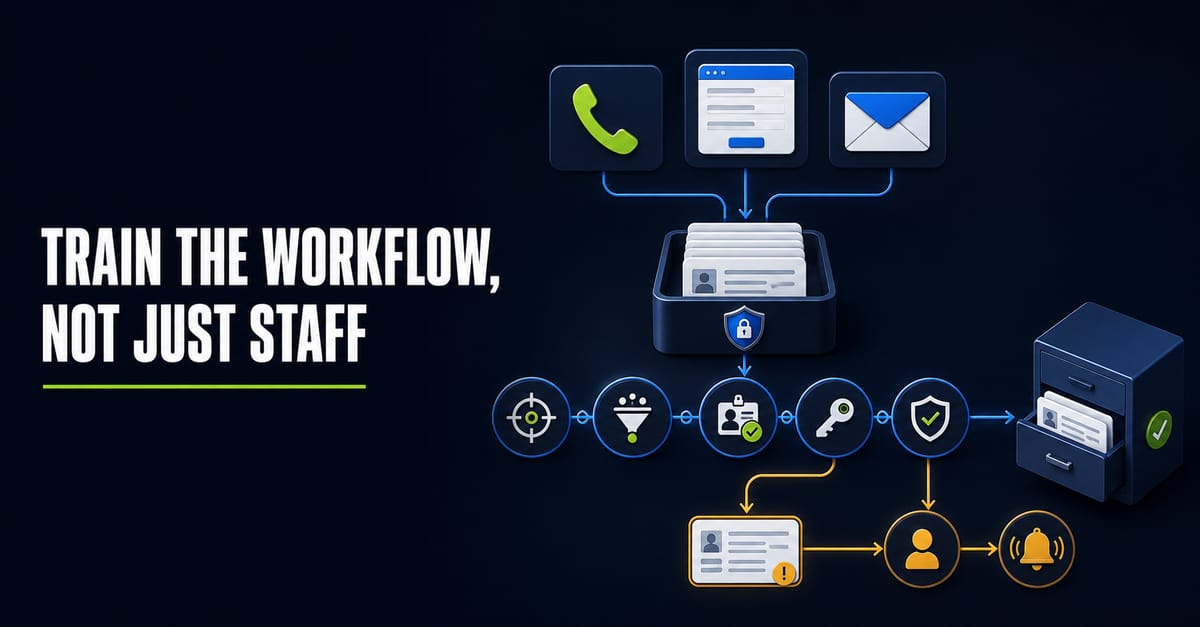
The practical answer to safer customer-data handling is to connect training to the decisions staff make during every call, form submission, email and hand-off. A useful data protection checklist for small business UK teams should therefore test the workflow, not simply confirm that employees completed a course.
That means defining why information is collected, limiting what staff request, verifying identity, controlling access and giving exceptions a clear owner. These controls should be visible in the form, script, record and escalation route used to complete the work.
What changed on 11 August 2026
On 11 August 2026, the Information Commissioner’s Office launched Data Protection Essentials for small and medium-sized organizations and sole traders across the UK. The ICO launch announcement says the free online programme covers information sharing, secure records, marketing and customer engagement, and reducing the risk of personal-data breaches.
The event date and ICO publication date were both 11 August. Northern Ireland’s official business information service published its own notice on 12 August, and LexisNexis UK reported the launch on the same date.
The programme includes examples for property, health and social care, professional services, retail, education and childcare. Individuals can receive a digital certificate. Organisations can also complete a self-assessment and choose whether to join a public register.
This is useful support, particularly for smaller businesses without dedicated data-protection expertise. But completion is the starting point. The business must still translate knowledge into repeatable frontline behaviour.
Why this matters to call-handling teams
A service organisation may receive the same customer issue through a telephone queue, website, shared inbox and messaging channel. Each route can ask for different information, create a separate record and assign access differently.
The risk is not confined to a dramatic cyber incident. It can begin with ordinary operational choices:
- An adviser asks for information that is not required.
- A web form collects sensitive detail before the case is properly classified.
- A caller’s identity is assumed because the telephone number looks familiar.
- An attachment is forwarded through an unapproved channel.
- Temporary staff can see records beyond their work.
- An access request or incorrect record sits in a general queue without an owner.
The ICO’s staff-training guidance says training should be relevant to each person’s role, refreshed regularly and cover what to do when something goes wrong.
That makes workflow design an important management responsibility. A generic annual course cannot tell an adviser which field to complete, which system is authoritative or who must receive an exception.
A five-point data protection checklist for small business UK operations
Use the following controls to test one real customer journey from receipt to closure.
1. Purpose
Write down why each item of personal information is required for the specific task. Link every form field, call-script question and CRM field to that purpose. If the team cannot explain why it is needed, pause before collecting it.
This is also the right point to compare the operating process with the organization's Don-Clem Technology privacy policy or its own equivalent notice. The public explanation and internal practice should not tell different stories.
2. Minimum
Remove questions and fields that do not support the immediate service decision. Do not use one oversized form for every enquiry because it is easier to administer.
A property maintenance request may need an address, contact details and access information. It does not automatically require every fact held in the tenancy record. A recruitment screening call may need different information from a payroll or placement process.
3. Identity
Define what staff must verify before they reveal, amend or share information. The control should match the risk of the action. Reading a general service update is not the same as changing a bank detail or discussing health information.
Put the required verification steps in the workflow. Do not rely on memory or personal judgement during a busy queue.
4. Access and transfer
Map who can view, edit, export and share each record. Then identify the approved route for every transfer between teams, suppliers and customers.
This is where an IT consulting and business systems review can help connect policy to website forms, CRM permissions, call scripts and hand-off rules.
The aim is not to add another tool. It is to make the approved action the easiest action to take.
5. Exception ownership
Create named routes for cases that should not remain in the normal queue. These may include an access request, inaccurate record, suspected breach, wrong-recipient message, identity doubt or a request involving sensitive information.
Each route needs an owner, a response expectation and an auditable record of what happened. If staff know that something feels wrong but do not know where to send it, the control is incomplete.
Illustrative property-service example
Consider an illustrative managing agent, not a Don-Clem Technology customer result. A tenant submits a repair through a web form and includes medical information to explain the urgency. They then telephone because the repair is worsening.
In a weak process, the form enters a shared inbox, the call adviser creates a second case and the full message is forwarded to several contractors. The organisation has duplicate records, uncertain ownership and wider access to sensitive detail than the repair requires.
In a controlled process, the web form explains what information is needed, flags sensitive detail for restricted handling and links the call to the existing case. The adviser follows an identity check, records only the service-relevant facts and sends the contractor the minimum information required. A named manager owns any privacy exception.
For firms assessing the wider customer journey, real estate technology solutions should support these rules across enquiry, maintenance and communication records.
What technology should and should not do
Technology should make agreed controls consistent. It can require essential fields, remove unnecessary ones, restrict access by role, preserve an action history, connect duplicate enquiries and route exceptions to the correct owner.
Technology should not decide the organisation’s purpose, lawful basis or acceptable risk without accountable human judgement. It should not hide unclear ownership behind automatic messages. It should not copy every employee into a case because visibility has been confused with unrestricted access.
Start with the operating decision. Configure the system only after the purpose, owner, access rule and exception route are clear.
Frequently asked questions
- Is completing the ICO training enough?
No. It can improve staff understanding, but the organisation must apply that understanding through appropriate policies, systems, supervision and daily controls.
- How often should staff receive data-protection training?
The ICO does not prescribe one interval for every organisation. It advises that training should suit the role and be refreshed regularly. Changes to systems, responsibilities or risks can justify an earlier refresh.
- Should every team use the same checklist?
Use the same control principles, then adapt the questions to each role. A call adviser, recruiter, field engineer and finance worker handle different information and make different decisions.
- Where should a small business begin?
Choose one common customer journey. Map the data received, the reason for collecting it, the people who can access it, every transfer and the route for exceptions. Fix the clearest gap before widening the review.
Conclusion
The ICO’s new programme gives smaller organisations a practical training resource. The management task is to ensure that staff encounter the same good decisions in the systems they use under pressure.