Care Home Business Continuity Plan for Ownership Change
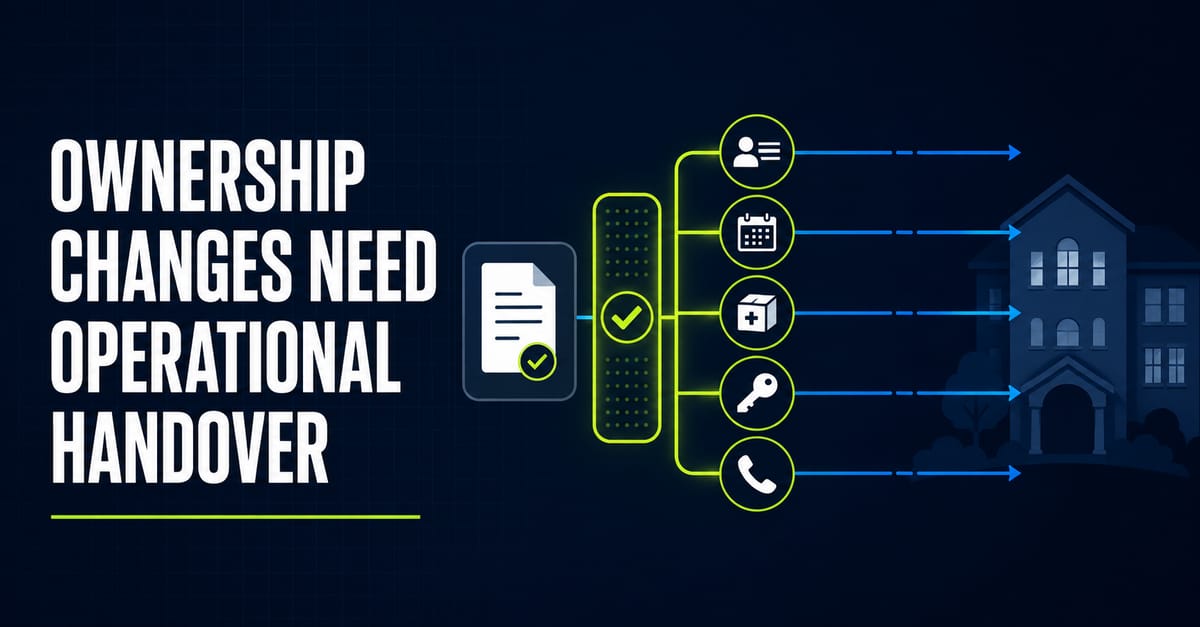
A care home business continuity plan in the UK should treat an ownership or operator change as an operational transition, not merely a legal transaction. Before the transfer date, leaders must confirm who owns every essential process, who can access the required information and how resident care will continue if a system, supplier or staffing handover fails.
The safest approach is to test the first working day before it arrives.
What happened on 12 August 2026
On 12 August 2026, The Times published an audit reporting that Welltower owned 920 properties used as care homes in the UK. The report placed renewed attention on the scale and structure of care-home ownership.
The dated news event should be distinguished from the transactions and regulatory process behind it. The Competition and Markets Authority says the relevant acquisitions were completed in October 2025. Its open merger-inquiries case, opened in January 2026, covers more than 600 operational care homes managed by Barchester Healthcare, HC-One, Aria Care and Danforth Care.
On 30 July 2026, the CMA began consulting on proposed undertakings. Earlier, it said the proposed remedies could include selling ownership of certain properties and reallocating the operation of some homes to another operator.
These proceedings concern competition and should not be treated as evidence that every affected home will experience operational disruption. They do, however, illustrate an important management reality: the property owner, registered provider and day-to-day operator may not be the same organization.
Why the transition matters operationally
Residents do not experience a transaction through ownership documents. They experience it through whether familiar care continues, staff have the right information, medicines and supplies arrive, repairs are handled and families know whom to contact.
An incomplete handover can leave essential work between organizations. Common gaps include:
- Access to care records being transferred later than expected.
- Rotas not matching payroll or agency arrangements.
- Suppliers holding the wrong purchase-order or invoicing details.
- Maintenance providers lacking authority to attend.
- Family and commissioner contacts remaining in an old system.
- Staff being unsure which manager can approve an urgent decision.
The risk is not limited to large acquisitions. The same control problem can occur when one operator takes over a single home, a group centralizes its systems or a service changes a critical supplier.
A care home business continuity plan UK leaders can apply
1. Map legal and operational responsibility
Create a simple responsibility map for the property owner, registered provider, operating company and local management team. For each essential service, identify who is accountable before, during and after the transition.
Do not assume that the organization paying for a service also controls daily decisions. Record the named decision owner and deputy.
2. Protect resident information and access
List every system and physical record needed to deliver care. Include care plans, risk information, medication records, family contacts, incident history and appointment information.
Confirm the lawful transfer approach, access permissions, retention requirements and reconciliation process with appropriate data-protection and professional advice. Test that authorized staff can find the correct record without exposing information unnecessarily.
3. Reconcile the workforce position
Compare the live rota with employment records, agency bookings, approved worker checks, payroll cut-offs, training status and on-call arrangements. Record any person whose status is uncertain and assign a resolution owner.
A staffing list is not sufficient if it does not show who is cleared, scheduled and available for each shift.
4. Reconfirm suppliers and property services
Review pharmacy, clinical supplies, food, laundry, waste, utilities, maintenance, security and emergency contractors. Confirm the contracting entity, account status, ordering method, delivery address, out-of-hours contact and approval limit.
This prevents a service from appearing active in a spreadsheet while the supplier is unable to accept an order from the incoming operator.
5. Control communication
Prepare an approved contact plan for residents, families, staff, commissioners, regulators and key partners. State what is changing, what is not changing, where questions should go and when the next update will be issued.
Give each audience one accountable communication owner. A general inbox without ownership is not a communication control.
6. Run a first-day operational test
Before transfer, simulate three realistic events: an unexpected staff absence, an urgent property repair and a safeguarding concern. Ask the team to locate the necessary information, reach the authorized person, record the decision and confirm follow-up.
The Care Quality Commission’s business continuity plan guidance describes a plan as showing how a care home will continue during and after disruption. A transition test should apply that principle to the exact systems and relationships being changed.
Illustrative residential-care example
Consider a residential-care group taking responsibility for an existing home. This is an illustrative example, not a Don-Clem customer result.
The legal transfer is scheduled for a Monday. The Rota appears complete, but two agency bookings were raised under the outgoing company’s account. The maintenance contractor also requires a new purchase order before attending.
During the pre-transfer test, the team simulates a night-shift absence and a failed boiler. The scheduler discovers that the agency cannot confirm the replacement under the old account. The on-call manager then finds that the engineer has no authority to attend.
Both gaps receive owners and deadlines before transfer. New account details are confirmed, escalation contacts are issued, and the scenario is repeated. The test has not guaranteed that no incident will occur. It has removed two preventable points of delay.
What technology should and should not do
Technology should provide one controlled view of transition actions, owners, evidence, deadlines, dependencies and unresolved risks. It should maintain appropriate permissions and preserve a clear record of approvals and handover decisions.
Don-Clem Technology’s healthcare technology solutions provide relevant context for organizations reviewing care-related operations. IT consulting for operational transition design can help map the workflow and safeguards before systems are configured. Where existing platforms cannot support the approved process, custom software development may be considered against documented requirements.
Technology should not decide regulatory responsibility, transfer sensitive data without an approved basis, replace clinical judgement or declare a transition safe because every task is marked complete. Accountable leaders must verify that the evidence is correct and the process works in practice.
Frequently asked questions
- Is a legal completion checklist enough?
No. Legal completion confirms the transaction. Operational readiness confirms that people, information, suppliers and decisions can continue supporting residents.
- When should transition testing begin?
Begin early enough to correct system, contract and workforce gaps before transfer. Repeat the test after material changes to the transition plan.
- Who should own the operational handover?
One accountable transition leader should coordinate it, while named owners remain responsible for care, workforce, property, suppliers, technology and communication.
- What evidence should be retained?
Keep the responsibility map, transition actions, approvals, access tests, reconciliations, scenario results and unresolved risks in a controlled record.
Conclusion
Ownership may change at a defined legal moment, but safe operational transfer depends on many connected decisions. A practical care home business continuity plan makes those dependencies visible and tests them before residents rely on the new arrangements.